Quick Answer: The best things to do in Stone Town are walking the old alleys to see the carved doors, visiting the Old Fort and seafront palaces, standing at the Old Slave Market memorial beneath Christ Church Cathedral, exploring Darajani Market, and ending at Forodhani Gardens for the evening food market. Most visitors need 2–3 hours with a guide, or a relaxed full day on their own.
Most people arrive in Stone Town with a list of sights and leave having found half of them. The lanes bend, the maps on your phone lose signal between tall coral-stone walls, and the doorway you were looking for turns out to be three alleys away. If you are wondering which things to do in Stone Town actually deserve your time — and in what order — this guide gives you the answer from the ground.
I’m Rama, and I’ve been guiding visitors through Stone Town since 2016. I grew up with these streets, so this isn’t a list copied from a guidebook. It’s the route I actually walk with guests, the stops that hold people’s attention, the ones you can skip, and the small details that make the difference between a hot, confusing morning and a day you remember.
Below you’ll find the main sights and what to expect at each, a walking route you can follow, the best time of day to go, what to wear, how much a guided walk costs, and how to fit Stone Town around your beach and boat days.
What Is Stone Town and Why Is It Worth Visiting?
Stone Town is the historic old quarter of Zanzibar City, on the west coast of Unguja island, and it is the cultural heart of Zanzibar. Its name comes from the coral stone used to build its houses, and in Swahili it is simply called Mji Mkongwe — the old town. In 2000 it was inscribed as a UNESCO World Heritage Site for the way its architecture records centuries of trade between Africa, Arabia, India and Europe.
It is worth visiting because nowhere else on the island explains Zanzibar so quickly. A single morning here shows you why the island smells of cloves, why its doors are carved, why so many languages are spoken in the market, and why its history carries real pain alongside the beauty.
How Big Is Stone Town?
Stone Town is small enough to cross on foot in about 15–20 minutes, but dense enough to get lost in for hours. The old quarter sits on a triangular point of land between the harbour and the Darajani road, and almost everything a visitor wants to see lies within that triangle. There are no cars in most of the inner lanes — only people, bicycles, scooters and the occasional handcart.
Is Stone Town Just for History Lovers?
No. Families enjoy the market colours and the tortoise boats leaving from the beach, photographers come for the doors and balconies, food lovers come for the night market, and couples come for the sunset on the seafront. History is the backbone, but the experience is mostly about atmosphere: the call to prayer, men drinking small cups of coffee on stone benches, children playing football in the lanes.
What Are the Best Things to Do in Stone Town?
The best things to do in Stone Town are the seafront monuments, the carved doors and inner alleys, the Old Slave Market site, Darajani Market and the Forodhani evening food market. Together they cover the town’s architecture, its history and its everyday life. Here is what to expect at each.
See the Old Fort (Ngome Kongwe)
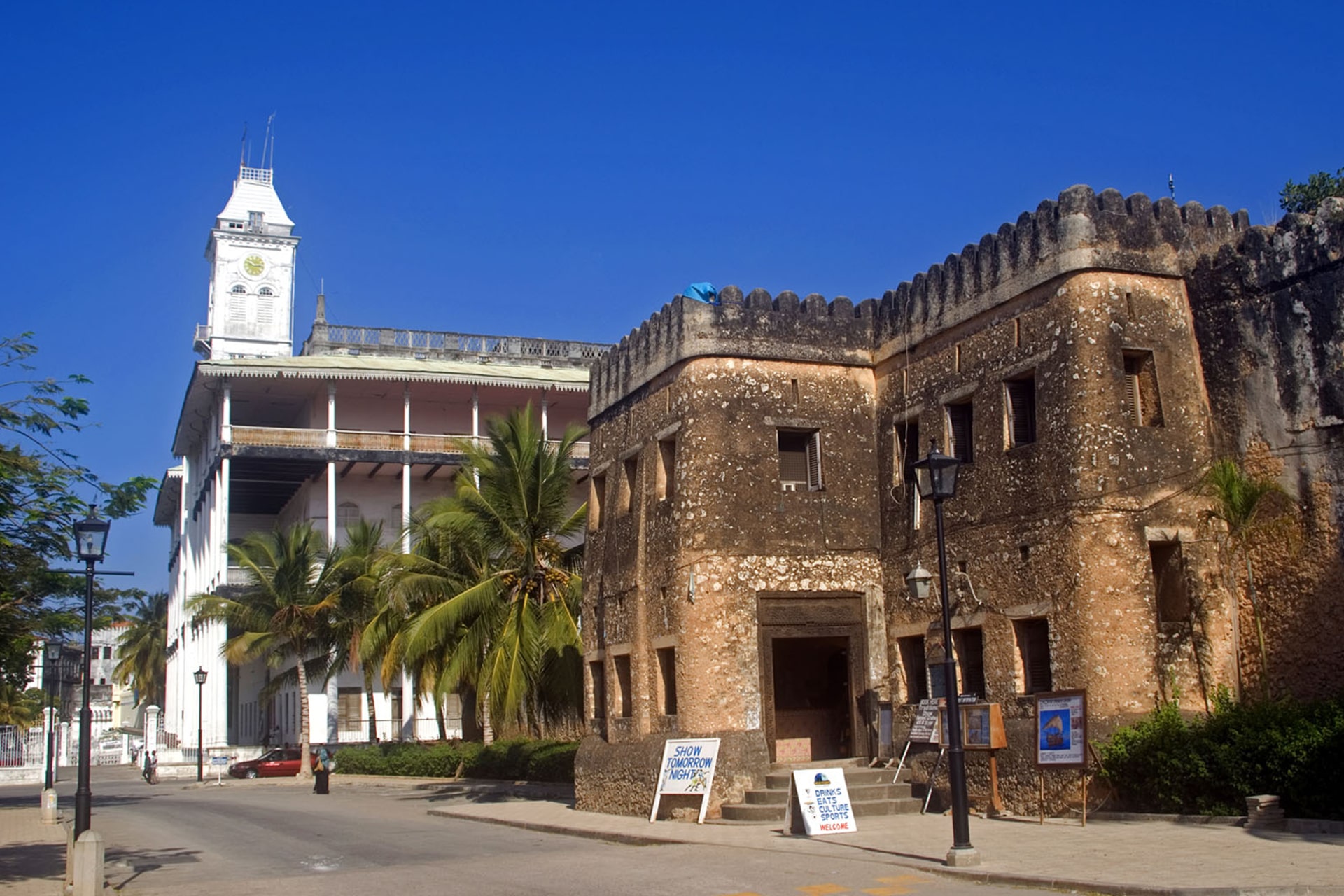
The Old Fort is the oldest standing building in Stone Town, built by Omani Arabs in the late 1600s on the seafront. Today its courtyard holds craft stalls and an open-air amphitheatre used for cultural events and festivals. Entry to the courtyard is free, and it is a good shaded place to start a walk and get your bearings.
View the House of Wonders from Outside
The House of Wonders (Beit al-Ajaib) was built in 1883 as Sultan Barghash’s ceremonial palace and was the first building in East Africa with electricity and an electric lift. Part of the building collapsed in December 2020, and it has been closed to the public during restoration ever since. You can still appreciate its scale and its tiered balconies from the seafront and the Old Fort; I always explain its history from there. If your trip is months away, ask us when booking — we’ll tell you the current status honestly.
Walk Past the Palace Museum and Old Dispensary
Along the waterfront you’ll pass the Palace Museum, once home to Zanzibar’s ruling family, and the Old Dispensary, whose carved wooden balconies and stained glass make it one of the most photographed façades on the island. Opening hours for the museum change, so check on the day if you want to go inside.
Read the Zanzibar Doors
Stone Town’s carved wooden doors are its signature. The broad rule is simple: square-topped doors with geometric carving are Omani in style, while doors with rounded tops and heavy brass studs show Indian influence. The carved chains, lotus flowers and fish on the frames carry meanings — protection, prosperity, fertility — and a good guide will show you how to read them. This is where a walk with someone local pays off most, because the best doors are tucked into lanes you wouldn’t find alone.
Visit the Old Slave Market and Christ Church Cathedral
This is the most important stop in Stone Town, and the most sobering. Christ Church Anglican Cathedral was built in the 1870s on the site of the last open slave market in East Africa, after the market was closed in 1873. Today the compound includes the East Africa Slave Trade Exhibit, the underground chambers where enslaved people were held before sale, and a memorial sculpture of chained figures standing in a pit.
There is an entry fee for the compound, which covers the exhibit, the chambers and the cathedral. Allow at least 30–40 minutes. I never rush this stop — guests often need time and quiet here, and I’d rather shorten another part of the walk.
Explore Darajani Market
Darajani is Stone Town’s main market and the busiest place in the old town. Under the market hall and the streets around it you’ll find fish and meat sections, fruit and vegetables, and spice stalls selling cloves, cinnamon, cardamom, black pepper and nutmeg. It is loud, crowded and fascinating. Go in the morning when it is at its liveliest, keep your bag in front of you, and ask before photographing traders.
See Freddie Mercury House
Freddie Mercury, born Farrokh Bulsara, spent his early childhood in Zanzibar. The house associated with his family now has a small museum, and it is a short walk from the seafront. It is a quick stop for most guests, and a highlight for music fans.
Visit the Hamamni Persian Baths
The Hamamni Baths were built for Sultan Barghash in the late 1800s as public bathhouses in the Persian style. They no longer hold water, but the domed chambers and plunge pools show how the town once lived. It is one of the quieter stops and rarely crowded.
Sit Down at a Baraza and Drink Swahili Coffee
The stone benches built into the walls of Stone Town houses are called barazas, and they are where the town talks. In the evenings, men gather on them with tiny cups of strong, ginger-spiced coffee poured from tall brass pots. Buying a cup costs very little, and it is the most local thing you can do in Stone Town.
End at Forodhani Gardens for the Night Market
Forodhani Gardens, on the seafront in front of the Old Fort, becomes an open-air food market from late afternoon. Stalls sell grilled seafood, skewers, “Zanzibar pizza” (a folded, griddle-cooked stuffed dough) and fresh sugarcane juice pressed with ginger and lime. Agree the price before your fish goes on the grill, and choose stalls where food is cooked fresh in front of you. Local boys diving off the seawall at sunset is part of the show.
What Is the Best Walking Route Through Stone Town?
The easiest route starts on the seafront and finishes at Forodhani Gardens, so you see the big monuments while you are fresh and end where the evening begins. This is the order I use on most walks, and it keeps backtracking to a minimum.
Route in Seven Stops
- Seafront start: Old Fort and House of Wonders (exterior)
- Waterfront walk: Palace Museum and Old Dispensary
- Into the alleys: carved doors, mosques and the Hindu temple area
- Old Slave Market: Christ Church Cathedral, exhibit and chambers
- Darajani Market: spice, fish and fruit sections
- Freddie Mercury House: short stop on the way back towards the sea
- Finish: Forodhani Gardens and the night market
At an easy pace with stops, this takes 2–3 hours. Add the Hamamni Baths or a museum interior and you’re looking at closer to 4 hours.
Can You Do Stone Town Without a Guide?
Yes — Stone Town is safe to explore on your own in daylight, and the seafront sights are easy to find. What you lose without a guide is the meaning: which doors are Indian and which Omani, what happened in the slave chambers, where locals actually eat. You’ll also be approached by papasi — the informal street touts who offer to guide you. They are mostly harmless, but a polite, firm “hapana, asante” (no, thank you) works best. A booked guide removes that friction completely.
How Long Do You Need in Stone Town?
Half a day covers the essentials, and one full day is ideal. A guided walk takes 2–3 hours; a full day lets you add a museum, a long lunch, a rooftop at sunset and the night market without rushing. Two nights in Stone Town makes sense if you also want to visit Prison Island or a spice farm from town.
Stone Town in Half a Day
Take a morning or late-afternoon guided walk along the route above. If you’re staying on the north or east coast, this is usually the best option — you visit Stone Town as a day trip and return to the beach by evening.
Stone Town in One Day
Walk in the morning, rest through the midday heat over lunch, then spend the late afternoon on the seafront. Many of our guests finish with a sunset dhow cruise from Stone Town, then walk straight into Forodhani for dinner. That’s the best version of a single day here.
Stone Town With Another Tour
Because the walk is short, it pairs naturally with other half-day experiences. The two most popular combinations are the Spice Farm & Stone Town combo tour, which adds a morning among clove and cinnamon trees, and the Stone Town & Prison Island combo tour, where a short boat ride takes you out to the giant Aldabra tortoises. If you’d rather see a slice of rural life too, the Village Tour & Stone Town combo contrasts the old capital with a working village.
When Is the Best Time to Explore Stone Town?
Stone Town can be visited all year, but the best time of day matters more than the month. Start before 9:30am or after 3:30pm. Between late morning and mid-afternoon the narrow lanes hold heat and there is little shade, especially in the hotter months from December to March.
[HTML BLOCK 3 — Morning vs Late Afternoon]
Which Months Are Most Comfortable?
The dry months from June to October are the most comfortable for walking, with lower humidity and cooler mornings. December to February is dry but hot. The long rains, roughly April and May, bring heavy showers — walks still run, but the lanes get slippery and some shopkeepers close early. For a month-by-month picture, see our guide to the best time to visit Zanzibar.
What Changes During Ramadan?
During Ramadan, many cafés and restaurants in Stone Town close during daylight hours, and eating or drinking openly in the street is considered disrespectful. After sunset, the town comes alive and Forodhani is busier than ever. Ramadan dates move each year, so check them when you plan.
What Should You Wear and Know Before Walking Stone Town?
Wear clothes that cover your shoulders and knees, and closed, comfortable shoes. Stone Town is a predominantly Muslim community, and modest dress is a sign of respect — it also protects you from the sun. Light cotton or linen is ideal.
Practical Tips From the Ground
- Shoes: the lanes are paved with uneven stone and can be slippery after rain; sandals with straps or trainers work best.
- Cash: carry small Tanzanian shilling notes and some US dollars for entry fees, coffee and market purchases. Card payments aren’t accepted everywhere.
- Water and hat: bring both, even on a short walk.
- Photography: always ask before photographing people, and respect “no photography” signs at religious sites.
- Mosques: most are not open to non-Muslim visitors; admire them from outside.
- Bargaining: expected in markets and craft stalls — keep it friendly.
- Getting there: if you’re staying outside town, arrange a private hotel transfer rather than negotiating a taxi on the day.
How Much Does a Stone Town Walking Tour Cost?
A guided Stone Town walking tour with Rama Zanzibar costs $50 for one person, $30 per person for 2–3 people, $25 per person for 4–6 people and $20 per person for 7–14 people, with further discounts for larger groups. The price includes a professional local guide, a bottle of water and all government fees. Hotel transfers can be added at extra cost if you’re staying outside Stone Town.
Entry fees for the Old Slave Market compound and any museum interiors are paid at the sites. For a wider view of what excursions cost across the island, our guide to Zanzibar tour prices breaks it down by tour type.
Is Stone Town Good for Families and First-Time Visitors?
Yes. The walk is flat, easy and suitable for all ages, and children usually love the market, the doors and the seafront. The one stop parents should think about is the Old Slave Market: the subject and the underground chambers can be confronting for young children. Tell us in advance, and the guide will adapt or shorten that part of the visit.
For first-time visitors, Stone Town is the best place to start a Zanzibar trip. Once you understand the town’s history, the rest of the island — the spice farms, the dhows, the villages — makes more sense. If you’re still building your plan, our overview of the best tours and excursions in Zanzibar shows how Stone Town fits alongside the beach and marine days.
If you want the history, the stories and the shortcuts without the stress, message us on WhatsApp and we’ll set a start time that suits your hotel and your day.
Frequently Asked Questions About Things to Do in Stone Town
Is Stone Town worth visiting?
Yes. Stone Town is the cultural and historical heart of Zanzibar and a UNESCO World Heritage Site. In one short visit you see the island’s Swahili, Omani, Indian and European heritage, the history of the East African slave trade, and the everyday life of a working town. Even travellers who come mainly for the beaches usually say Stone Town was one of the most memorable parts of their trip. A half-day is enough to understand it; a full day lets you enjoy it slowly.
How many days do you need in Stone Town?
One full day is ideal for most visitors. That gives you time for a guided morning walk, a relaxed lunch, the seafront in the late afternoon and dinner at Forodhani. If you only have half a day, a 2–3 hour guided walk covers the essential sights. Two nights in Stone Town make sense if you also want to visit Prison Island, a spice farm or a nearby sandbank, since all of them leave from or close to town.
Can I walk around Stone Town on my own?
Yes. Stone Town is generally safe to explore on foot during the day, and the main seafront sights are easy to find. The inner lanes are confusing, though, and phone maps often lose accuracy between the tall buildings. Expect to be approached by street touts offering to guide you. Walking alone works well for wandering; a guided walk is better if you want to understand what you’re seeing and reach the hidden lanes without getting lost.
Is the House of Wonders open?
No. The House of Wonders has been closed to visitors since part of the building collapsed in December 2020, and restoration work has been ongoing since then. You can still see it from the seafront and the Old Fort, and a guide will explain its history there — including why it was called the House of Wonders. Because the reopening date isn’t confirmed, ask for the latest status when you book.
What is the best time of day to explore Stone Town?
Early morning and late afternoon are best. Morning, from about 8:00am, brings cooler air and the busiest market. Late afternoon, from about 3:30pm, has softer light for photos and finishes at Forodhani Gardens as the night food market opens. Avoid walking between about 11:00am and 3:00pm in the hotter months, when the narrow lanes trap the heat.
What should I wear in Stone Town?
Wear loose, light clothing that covers your shoulders and knees, whether you’re a man or a woman. Stone Town is a conservative, predominantly Muslim community, and modest dress is respected. Swimwear and very short shorts are fine on the beach but not in town. Choose closed shoes or sturdy sandals for the uneven stone lanes, and bring a hat and sunscreen.
Is the Forodhani night market safe to eat at?
Generally yes, if you choose sensibly. Pick stalls that are busy and cooking food fresh in front of you, and avoid seafood that has been sitting out since the afternoon. Agree on the price before the food goes on the grill, because quotes for seafood can be high for visitors. Sugarcane juice pressed on the spot and freshly made Zanzibar pizza are safe and popular choices.
Can I visit Stone Town if I’m staying in Nungwi or Paje?
Yes. Stone Town is an easy day trip from anywhere on the island. Drive times vary with traffic and road conditions, so most guests from the north and east coasts leave their hotel in the morning and are back by evening. We arrange pickup from any hotel on the island, and you can combine Stone Town with a spice farm visit on the way to make the drive more worthwhile.
Final Thoughts on Things to Do in Stone Town
The best things to do in Stone Town aren’t complicated — they just need the right order and a little local knowledge.
- See the monuments first: start at the Old Fort and seafront while you’re fresh.
- Give the Old Slave Market time: it’s the stop that stays with people.
- Go early or late: avoid the midday heat in the lanes.
- Finish at Forodhani: sunset and street food are the best ending to any Stone Town day.
I’ve walked these streets with travellers from all over the world since 2016, and the town still surprises me. Whether you want a short walk before your beach days or a full day with a spice farm or Prison Island, we’ll build it around you. Send us a message on WhatsApp at +255 773 315 736, and we’ll help you plan your Stone Town visit.